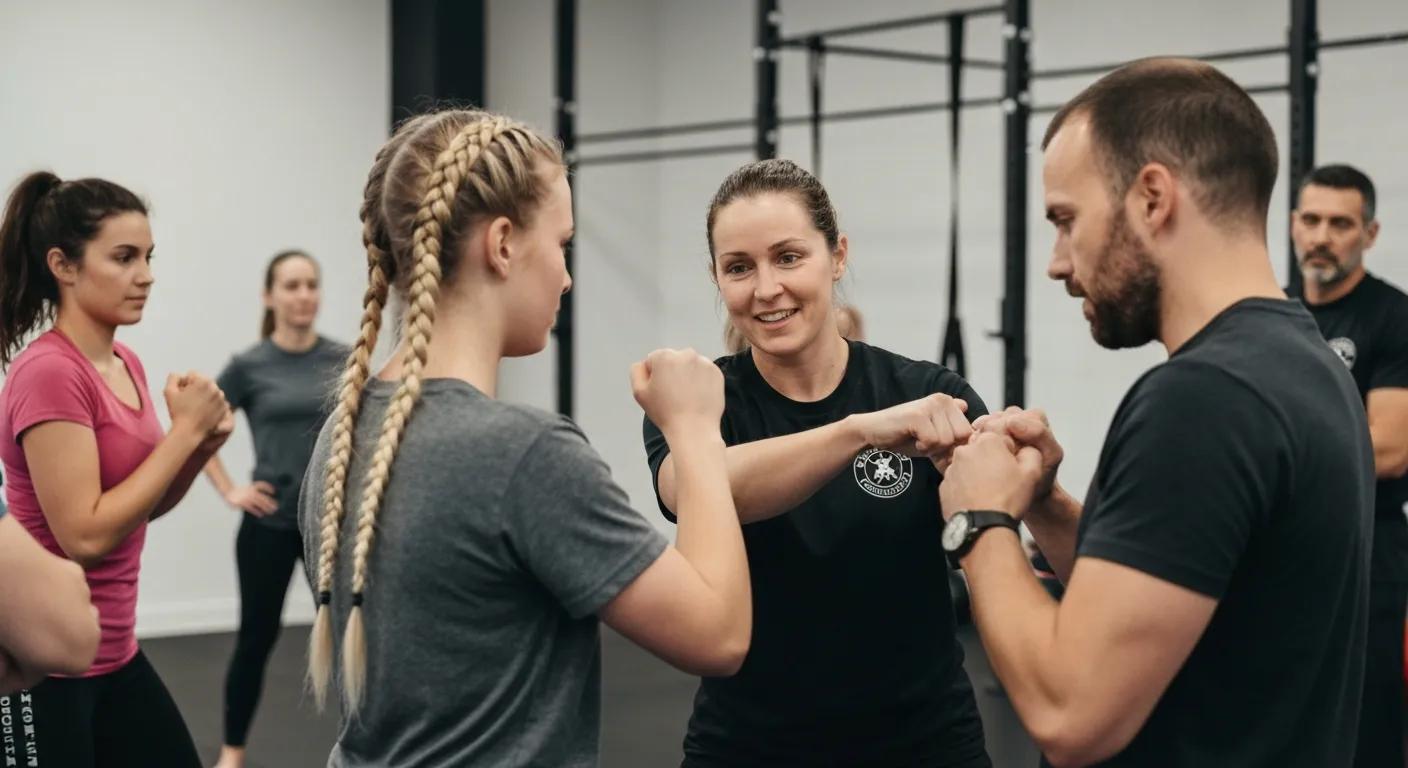
Beginner Self-Defense in Northglenn: Simple, Effective Striking Basics
Beginner Self-Defense in Northglenn


Self-defense striking basics give beginners practical, high-impact options to create space, escape danger, and increase personal safety in everyday Northglenn scenarios. This guide teaches easy-to-learn strikes, safe practice drills, and how to begin training locally so newcomers gain usable skills quickly without complex techniques. Readers will learn core moves—palm strike, elbow strike, and front kick—why they work, where to aim, and safe progressions to build speed and confidence. Common beginner concerns such as fear of contact, unsure expectations for the first class, and choosing the right training style are addressed with clear next steps and local options. The article maps striking techniques, compares beginner-friendly styles, outlines benefits for safety and fitness, explains women’s and kids’ program features, and shows how Northglenn residents can find and register for classes. By focusing on simple mechanics and practical drills, this resource helps beginners turn knowledge into quick, usable self-defense responses.
What Are the Essential Striking Techniques for Beginner Self-Defense in Northglenn?
Essential striking techniques for beginners are simple, high-leverage moves that create an opening to escape and are safe to practice: the palm strike, elbow strike, and front kick. These strikes work because they use sturdy parts of the body (heel of palm, forearm/elbow, and shin/instep) to transfer force efficiently while minimizing risk to the striker, producing a practical outcome of distraction and space to flee. Learning target areas—nose, chin, throat, solar plexus, and groin—helps learners prioritize effectiveness over power, which is critical for beginners training in Northglenn. The section below breaks each technique into actionable mechanics, common mistakes to avoid, and short partner or shadow drills to develop timing and confidence. After mastering basic mechanics, students progress to integrating strikes into situational awareness and escape drills that reflect local safety concerns.
Learning the mechanics first reduces injury and accelerates usable skill acquisition, so begin with stance and alignment before adding speed. The following subsections guide you through palm and elbow strikes with step-by-step practice suggestions that transition smoothly into partner drills and brief conditioning.
How to Master the Palm Strike for Quick Defense
A palm strike is a safe, powerful choice for beginners because the heel of the hand delivers force without risking knuckle injury, and it requires minimal precision to affect an attacker. Start from a balanced stance with knees slightly bent, lead foot forward, and hips engaged; push through the legs and rotate the torso while driving the heel of the palm toward the target. Aim for vulnerable zones such as the nose, chin, or solar plexus, and focus on short, explosive motion rather than swinging wide; this reduces telegraphing and increases speed. Common mistakes include overreaching, locking the wrist, and relying on arm strength instead of body rotation; correct these with slow, repeated shadow-strikes and light pad work. Progress drills:
ten controlled palm strikes into a pad focusing on hip rotation
partner mitt exchanges at slow speed
a 30–60 second burst drill to build speed and breath control—these progressions prepare the palm strike for realistic escapes
Practicing palm strikes with these progressions leads naturally to learning close-range options like the elbow strike, which is more effective at intimate distances.
What Makes the Elbow Strike Effective for Beginners?

The elbow strike is highly effective at close range because the elbow is a dense, compact striking surface that concentrates force into a small area, producing significant impact with minimal wind-up. Mechanics center on short-range rotation: bend the arm slightly, drive the elbow with torso twist, and maintain a stable base to avoid overbalancing. Safe practice emphasizes controlled contact on pads and slow technical repetition to condition the arm and shoulder; beginners should avoid full-power strikes on unprotected partners. Variations include horizontal elbow (across the chin), diagonal elbow (toward the temple), and downward elbow (to the collarbone), each suited to different close-contact situations. A beginner-friendly drill is partner clinch-and-release: clinch lightly, create a small separation, then perform a single controlled elbow to a pad; repeat for timed sets to build timing and recovery habits.
Mastering the elbow advances a student’s ability to handle contact-range encounters and prepares them to integrate strikes into simple escape sequences, which we explore in training and class onboarding guidance.
How Can Beginners Start Self-Defense Training at Grinders Fitness Gym in Northglenn?
Starting self-defense training as a beginner means focusing on predictable, incremental learning that builds safety skills and confidence while minimizing intimidation. A typical onboarding approach emphasizes essentials: a brief warm-up that primes mobility, focused technical instruction on a core strike or escape, structured partner drills with safety protocols, and a cool-down that reinforces feedback and homework drills. Prioritizing repetition, safe partner rules, and small measurable milestones (e.g., perform 10 controlled palm strikes with correct rotation) gives beginners clear progression markers that reduce anxiety about starting training. Before the first session, simple preparations—comfortable athletic clothing, water, and openness to learning—help students get the most from early classes and accelerate skill retention.
Grinders Fitness Gym is a local Northglenn facility that offers beginner-friendly self-defense and striking fundamentals as part of its class lineup; prospective students can contact the gym via its official website to inquire about beginner courses, class formats, and enrollment steps. Many local gyms structure beginner blocks around progressive skill sets that build competence in striking, awareness drills, and safe partner work; asking about class pacing and beginner-specific sessions helps ensure a comfortable first experience. If you want to begin training promptly, prepare a short list of questions—about beginner pacing, contact level, and recommended practice between classes—to use when reaching out to the gym, and this will make enrollment and initial progress more straightforward.
Taking these first steps into training leads directly to understanding what a typical beginner class looks like and how regular sessions translate into fitness and confidence gains.
What to Expect in a Beginner Self-Defense Class in Northglenn
A beginner self-defense class usually begins with a joint-friendly warm-up that targets mobility, balance, and light cardio to prepare students for safe striking drills. The main segment focuses on one or two technical elements—stance, palm strike, elbow mechanics, or a short front kick—broken down into drills, partner practice with strict safety rules, and supervised repetitions to ingrain correct mechanics. Classes often end with situational application drills (escape scenarios, movement to safety) and a cooldown that reviews key takeaways and at-home practice suggestions to accelerate learning. Safety protocols typically include controlled contact, mandatory protective equipment for certain drills, instructor oversight, and a culture of clear communication between partners. Expect paced progression where instructors prioritize technical control before power; this structure reduces risk and builds reliable, actionable skills that transfer to real-world encounters.
Understanding this class flow makes it easier to identify programs that match your comfort level and training goals, which in turn helps you choose between styles and session formats.
How Do Self-Defense Classes Build Confidence and Fitness?
Self-defense classes build confidence by converting abstract fear into concrete skills—learners practice targeted strikes and escape drills until responses become procedural, which reduces hesitation under stress. Physically, striking training delivers cardiovascular conditioning, coordination improvements, and functional strength gains through repetitive, full-body movements that integrate hips, core, and limbs. Psychologically, structured progress, measurable milestones, and positive coaching feedback reinforce a growth mindset that extends beyond training into daily life. At-home drills, short shadowwork sessions, and consistent class attendance amplify both skill retention and fitness outcomes, speeding the confidence loop from tentative to assured. These combined effects motivate continued training and make personal safety habits habitual, which is especially valuable for beginners focused on practical outcomes.
That reinforced confidence and fitness is best matched to the right style for a beginner’s goals, which is why style selection matters and is covered next.
Which Self-Defense Styles Are Best for Beginners in Northglenn?
Choosing a beginner-friendly style depends on whether you prioritize striking fundamentals, reality-based defense, or ground control; Kickboxing, Krav Maga, and Brazilian Jiu Jitsu (BJJ) each map to distinct beginner outcomes. Kickboxing emphasizes striking technique, conditioning, and rhythmic combinations that rapidly build power and timing for standing encounters. Krav Maga focuses on simple, repeatable defenses and aggressive escapes suited for real-world unpredictability and stress. BJJ concentrates on ground control, escapes, and positional defense—vital if altercations go to the ground. The table below compares these styles on what beginners can reasonably expect to achieve early in training and clarifies which learning pathway fits different priorities.
Kickboxing
Best For: Standing striking & conditioning
Beginner Outcome: Rapid improvement in punches, kicks, timing, and cardio
Krav Maga
Best For: Reality-based defense & escapes
Beginner Outcome: Practical, easy-to-apply defenses and escape drills
Brazilian Jiu Jitsu (BJJ)
Best For: Ground control & escapes
Beginner Outcome: Ability to control distance, escape mounts, and defend on the ground
How Does Kickboxing Compare to Krav Maga for New Learners?
Kickboxing and Krav Maga both offer beginner-friendly paths but differ in focus and class structure; Kickboxing teaches striking mechanics, combinations, and conditioning routines with a technical progression. Krav Maga simplifies techniques into instinctive responses and situational drills that emphasize immediate escape over form perfection. For a beginner seeking fitness and striking fluidity, Kickboxing yields measurable conditioning and technical skills; for someone prioritizing quick, stress-tested defenses for unpredictable scenarios, Krav Maga presents straightforward, scenario-based training. Considerations: Kickboxing classes often include pads and sparring drills for timing, while Krav Maga classes frequently include scenario training and aggressor-practice; choose according to whether technical striking skill or practical escape simplicity is the priority.
Deciding between striking and ground control leads many beginners to pair striking classes with occasional BJJ sessions, which is explained next.
What Are the Benefits of Brazilian Jiu Jitsu for Self-Defense Beginners?
Brazilian Jiu Jitsu offers beginners a reliable method for controlling an aggressor on the ground and escaping from disadvantaged positions, making it a critical complement to standing striking skills. BJJ’s core value is leverage-based techniques that let smaller practitioners control larger opponents through position, joint control, and escapes, teaching problem-solving under pressure. Typical beginner drills include shrimping, bridging, basic guard passes, and escape sequences that develop positional awareness and timing rather than raw striking power. Combined with striking training, BJJ completes a beginner’s toolkit by addressing ground vulnerability and teaching calm problem-solving under fatigue, which significantly increases overall practical self-defense capability.
Having explored styles, the next section maps the practical benefits learners experience from striking-focused training in Northglenn.
What Are the Key Benefits of Learning Self-Defense Striking Basics in Northglenn?
Learning striking basics delivers three practical benefits: increased immediate escape options, measurable fitness improvements, and stronger situational confidence that reduces victimization risk in everyday environments. Striking provides tools to create space, distract an attacker, or disable a threat long enough to exit, while training routines enhance cardiovascular capacity, coordination, and muscle endurance. Mentally, repeated successful practice reduces anxiety around confrontations and improves decision-making under stress, which compounds into safer behavior patterns. The table below maps these benefits to the mechanisms that create real-world outcomes, clarifying how training yields concrete improvements.
These mapped outcomes show why striking basics are a high-value starting point for beginners who want practical, quickly applicable self-defense skills.
How Does Self-Defense Training Improve Personal Safety and Awareness?
Self-defense training improves safety primarily by sharpening situational awareness and teaching automatic responses that prioritize escape and avoidance over confrontation. Training routines include observation drills, threat recognition practices, and scenario-based rehearsals that condition students to notice cues, maintain distance, and choose escape routes. Striking basics augment these skills by providing simple, high-probability responses that create separation; for instance, a well-timed palm strike can allow an immediate exit from a close-contact situation. Regular practice of observation and response drills builds mental readiness and reduces freeze responses, so students are quicker to act and more likely to choose safe outcomes.
Improved awareness and safe response patterns also deliver broader fitness and mental health benefits that support ongoing training and resilience.
What Fitness and Mental Health Benefits Come from Martial ArtsTraining?
Martial arts striking training enhances cardiovascular endurance, muscular coordination, core strength, and reflex speed through repetitive, full-body movements and interval-style drills. Mentally, consistent training reduces stress, advances mood regulation, and increases resilience through measurable progress and social support within class environments. Frequency matters: attending 2–3 classes per week typically yields noticeable fitness and stress-reduction benefits within a few weeks, while shorter daily at-home drills reinforce motor learning and confidence. As fitness improves, cognitive benefits emerge—better focus, stress coping, and confidence—which together create a positive feedback loop that sustains practice and real-world preparedness.
Those program-level benefits inform how women and children can access tailored programs that address specific needs, which is the focus of the next section.
How Can Women and Kids in Northglenn Access Specialized Self-Defense Programs?
Specialized women’s and kids’ programs focus on age- and gender-specific scenarios, boundary-setting, and safe drills that build confidence without unnecessary aggression. Women’s classes typically emphasize situational awareness, verbal assertiveness, escape-focused strikes, and close-contact defense techniques that are practical in confined spaces. Kids’ programs center on anti-bullying curricula, role-play, de-escalation, and simple physical techniques appropriate for developmental levels, plus parental communication about progress and safety protocols. When evaluating programs, look for clear policies on instructor training, child-friendly teaching methods, and instructors who articulate safety measures and progression paths.
Next we outline specific features to look for in women’s classes and how kids’ programs structure learning to be age-appropriate.
What Are the Features of Women’s Self-Defense Classes in Northglenn?

Women’s self-defense classes commonly include situational awareness training, boundary-setting practice, short powerful strikes (palm/elbow/front kick), and escape sequencing tailored to close-contact scenarios. Instructors often incorporate verbal assertiveness drills and scenario rehearsals that emphasize getting to safety rather than prolonged confrontation, and they adapt contact levels to participant comfort while progressing with consent-based partner work. A useful checklist for assessing a women’s class includes instructor clarity on safety, a curriculum that emphasizes practical escapes, and opportunities for repeated practice in controlled drills. These program features ensure the training is empowering, practical, and focused on real-world outcomes rather than sport competition.
These program elements double as a blueprint for kids’ modules, which are designed with age-appropriate content and parental involvement.
How Do Kids’ Anti-Bullying and Self-Defense Programs Work?
Kids’ programs use game-based drills, role-play scenarios, and clear behavioral rules to teach de-escalation, boundary setting, and simple physical escapes in a safe environment; the emphasis is on confidence and communication rather than harm. Age-appropriate progressions start with awareness and assertiveness, move to non-harmful physical escapes, and include parent updates and take-home exercises to reinforce learning outside class. Typical class structure balances movement, skill instruction, and supervised partner activities that build coordination and social skills while modeling non-violent conflict resolution. These features make programs effective for reducing bullying risk and helping children practice calm responses under peer pressure.
With knowledge of specialized programs, the final section shows practical actions Northglenn residents can take today to find and join beginner classes.
Where and How Can Northglenn Residents Join Beginner Self-Defense Classes Today?
Finding and joining beginner self-defense classes involves targeted search, credential checks, and trialing classes to ensure fit and comfort. Start by identifying facilities offering beginner-focused sessions and reviewing class descriptions to verify beginner pacing, safety protocols, and instructor experience; then prioritize options that allow a trial class or drop-in session to assess teaching style. When contacting providers, ask about beginner blocks, expected contact levels, protective gear requirements, and recommended at-home practice—these questions clarify expectations and reduce first-class anxiety. Typical schedules for beginners often include multiple weekly sessions with options for drop-in, trial, or short-term beginner courses; pricing models vary but commonly include single-class drop-ins, monthly memberships, and introductory trials.
Drop-in Beginner Class
Duration / Frequency: 60 minutes / weekly or biweekly
Typical Beginner Schedule: Single session to sample instruction and pacing
Beginner Course Block
Duration / Frequency: 6–8 weeks, 1–2x per week
Typical Beginner Schedule: Progressive curriculum with measurable milestones
Membership Classes
Duration / Frequency: Ongoing, multiple sessions per week
Typical Beginner Schedule: Flexible attendance, best for steady progress
Comparing class formats helps residents choose a practical onboarding path; the final subsection provides a concise checklist for registering with a local gym option.
How to Find and Register for Self-Defense Classes at Grinders Fitness Gym
To register for beginner self-defense classes at Grinders Fitness Gym, prepare a short checklist of questions about beginner pacing, safety protocols, and trial-class options to ensure the program matches your comfort level and goals. Use the gym’s official website as the primary contact point to inquire about current beginner sessions and to request information on class blocks, protective gear, and instructor experience; avoid assuming schedules or prices without confirmation.
Bringing this information to your inquiry simplifies enrollment and ensures your first classes are productive and confidence-building.
What Are the Class Schedules and Pricing Options for Beginners?
Common pricing and schedule frameworks include single-class drop-ins, introductory trial classes, short beginner course blocks, and monthly memberships that offer the best value for regular attendance. Drop-in classes let you sample instruction with low commitment, beginner blocks provide structured progression over several weeks, and memberships or unlimited options work well for faster skill acquisition through frequent practice. When comparing options, ask about refund policies for trials, discounts for multi-week beginner blocks, and whether protective equipment is included or required; these details determine overall cost-effectiveness. Choosing the most appropriate model depends on your availability and commitment goals—short blocks suit those testing interest, while memberships benefit learners aiming for steady progression.
These practical steps complete a clear pathway from learning essential strikes to joining local training in Northglenn and turning basic skills into reliable personal safety habits.
Frequently Asked Questions
1. What should I wear to my first self-defense class?
For your first self-defense class, it's best to wear comfortable athletic clothing that allows for a full range of motion. Opt for moisture-wicking fabrics to keep you dry during workouts. Supportive athletic shoes are recommended, especially if the class involves striking or footwork drills. Avoid overly loose clothing that could get caught during practice. Bringing a water bottle is also a good idea to stay hydrated. Being comfortable will help you focus on learning the techniques without distractions.
2. How can I practice self-defense techniques at home?
Practicing self-defense techniques at home can be done safely and effectively. Start with shadowboxing, where you visualize an opponent and practice your strikes and movements in the air. Use a mirror to check your form and technique. You can also practice footwork drills in a small space. If you have access to a heavy bag or pads, incorporate striking drills to build power and accuracy. Always prioritize safety and avoid practicing techniques that require a partner unless you have one available.
3. Are self-defense classes suitable for all fitness levels?
Yes, self-defense classes are designed to accommodate various fitness levels. Instructors typically tailor their teaching methods to ensure that everyone, from beginners to more experienced individuals, can participate and benefit. Classes often start with basic techniques and gradually increase in intensity and complexity. It's important to communicate any concerns about your fitness level to the instructor, who can provide modifications or alternative exercises to ensure a safe and effective training experience.
4. How long does it take to become proficient in self-defense?
The time it takes to become proficient in self-defense varies based on individual commitment, practice frequency, and the complexity of techniques being learned. Generally, consistent training over several weeks or months can lead to noticeable improvements in skills and confidence. Many beginners start feeling more comfortable with basic techniques after attending classes regularly for about 6 to 8 weeks. Continued practice and participation in drills will further enhance proficiency and readiness for real-world situations.
5. Can self-defense training help with mental health and stress relief?
Yes, self-defense training can significantly benefit mental health and stress relief. Engaging in physical activity releases endorphins, which can improve mood and reduce anxiety. The structured environment of self-defense classes fosters a sense of community and support, helping individuals feel more connected. Additionally, learning self-defense techniques can boost self-esteem and confidence, which contributes to overall mental well-being. Regular practice also provides a productive outlet for stress, allowing individuals to channel their energy positively.
6. What should I expect during my first self-defense class?
During your first self-defense class, expect a welcoming environment focused on learning and safety. Classes typically begin with a warm-up to prepare your body, followed by instruction on basic techniques such as strikes and stances. Instructors will guide you through drills, emphasizing proper form and safety protocols. You may also engage in partner exercises to practice techniques in a controlled manner. The class will likely conclude with a cooldown and a review of what you learned, along with suggestions for practice at home.
7. Are there age restrictions for self-defense classes?
Age restrictions for self-defense classes vary by facility and program. Many gyms offer classes specifically designed for children, teens, and adults, ensuring that the content is age-appropriate and safe. Some programs may have minimum age requirements, while others may allow younger participants with parental consent. It's best to check with the specific gym or instructor to understand their policies and find a class that suits your age group and skill level.
Conclusion
Mastering self-defense striking basics equips beginners with essential skills for personal safety, fitness, and confidence in everyday situations. By focusing on practical techniques like palm strikes and elbow strikes, learners can effectively create space and escape from potential threats. Engaging in local classes not only enhances physical abilities but also fosters a supportive community for ongoing growth. Take the first step towards empowerment by exploring beginner self-defense classes at Grinders Fitness Gym today.
